
Today, many watched Major General Ali Abdollahi, chief of staff of Iran's armed forces, and Brigadier General Majid Mousavi, commander of the IRGC Aerospace Force, tour a “new” underground missile city. These days, nobody is asking the obvious questions. When were these facilities dug, and how? Who is behind them? And what was everyone else thinking while it happened? One thing that often gets overlooked is the connection between these underground missile cities and Iran's water mafia. Let's dig into it.
For years, I have been deeply concerned about interbasin water transfers in Iran. Planners have ignored the environmental characteristics and ecological limits of the country's river basins, and that failure has created serious problems both in the basins that supply water and in those that receive it. One prominent example is the transfer of water from the Greater Karun Basin to the Central Plateau. These projects have caused considerable environmental damage in parts of the Greater Karun Basin, while encouraging higher water consumption and creating unsustainable dependencies across the Central Plateau.
But my concern today goes beyond water transfers. In a 2021 article for the Middle East Institute, I examined the role of the Islamic Revolutionary Guard Corps (IRGC) in what I described as Iran's water mafia. One of this network's significant activities has been the construction of long tunnels, ostensibly for interbasin water transfers. Some of these tunnels were excavated in southern and southwestern Iran, others in the west of the country. Those are the projects that the IRGC and the Ministry of Energy have publicly announced. The question is: what about the projects that were never announced?
Information circulating among water-sector specialists in recent years points in that direction. According to some of them, extensive tunneling may also have taken place in areas with no obvious connection to major water-transfer projects. Last year, a water management specialist who had worked for Mahab Ghodss told me about the movement of equipment associated with tunnel boring machines (TBMs) in parts of the Central Plateau, particularly Yazd Province. To protect the source, I cannot share further details.
TBMs, sometimes nicknamed “moles,” are enormous machines that excavate tunnels through rock and soil. Depending on their design and the geology, they can work far beneath the surface and leave relatively little disturbance above the tunnel alignment. The specialist's account raised the possibility that some of these machines, or their associated equipment, were used to build underground infrastructure for military purposes, potentially including facilities connected to Iran's nuclear program. I cannot independently verify that account.
The movement of tunneling equipment does not, by itself, establish the purpose of an underground excavation. Still, the possibility deserves careful investigation.
Reliable information about underground construction is extremely hard to obtain from a distance. Yet major tunneling projects can leave traces on the surface. Historical satellite imagery and time-lapse comparisons could reveal changes in access roads, construction compounds, excavation sites, and equipment routes, as well as the accumulation or removal of excavated rock over long periods. Such evidence would not necessarily reveal what was being built underground, but it could help establish whether substantial construction took place in a particular area.
Some of these locations may lie within restricted or heavily protected zones, where ordinary citizens have little or no access. People who travel through remote areas for environmental research, recreation, or hunting occasionally run into unexpected restrictions or security activity. In sensitive locations, such encounters can carry serious personal consequences.
Meanwhile, the photographs and videos Iran has released of its underground missile facilities show the considerable scale of the country's subterranean military infrastructure. They naturally raise questions about how much underground construction exists elsewhere in Iran, particularly in regions with competent bedrock and geological conditions suited to large underground works.
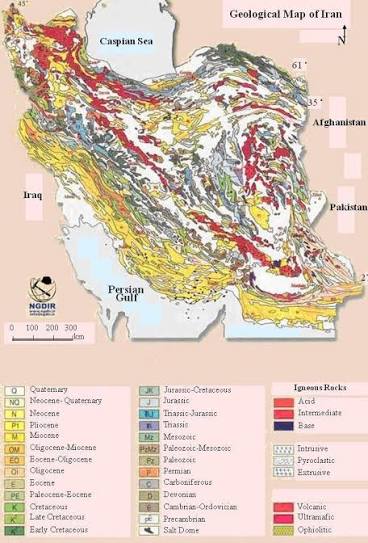
My own interest in this subject comes partly from my background in geology. I studied geology and sedimentology, have visited many regions of Iran, and have examined geological maps of much of the country, so I am familiar with how much its formations vary. Areas dominated by intrusive igneous rocks and metamorphic formations are of particular interest. Depending on their fracturing, weathering, groundwater conditions, and structure, some of these rock masses may provide suitable environments for underground engineering.
But rock type alone cannot determine whether an area is suitable for tunneling, let alone whether underground facilities actually exist there. The central question, then, is not simply where Iran has rock formations capable of accommodating major underground structures. It is whether publicly available evidence can help distinguish ordinary civil engineering projects from unexplained underground construction.
If heavy tunneling equipment has been moved into regions with no documented water-transfer, transportation, or other civilian infrastructure projects, those movements deserve scrutiny. But scrutiny must begin with evidence, not assumptions.
The machines themselves came from abroad, sold in the name of civilian projects: metro lines, sewage systems, and water tunnels. According to the advocacy group United Against Nuclear Iran, Germany's Herrenknecht was the leading supplier of TBMs to Iran, and another German firm, Aker Wirth, had three machines working in the country in 2009. Italy's SELI, Canada's Lovat, and a Japanese manufacturer also appear in its records. Herrenknecht has said its equipment went only to clearly civilian projects. That may be true on paper. But many of those civilian projects were run by contractors tied to the IRGC, and the same organizations dig for the military.
Since The New York Times reported in 2010 that Iran was hiding its nuclear work in a maze of tunnels, many have known about the regime's efforts to dig and build these underground facilities. So my bigger question is this: how were the IRGC and its allies still able to buy these huge machines?
Iran's history of large-scale water-transfer tunneling, the involvement of powerful construction organizations, and the existence of substantial underground military installations make the subject worthy of independent geological and investigative research. The challenge is to determine what can actually be established, what remains uncertain, and what questions should be asked about the extensive engineering taking place beneath Iran's surface.